

Can WK-113-1960 be used in combination with other products from the same brand?
Nov 09, 2026
In short
• WK-113-1960 is cut for the 1960 Beetle shell, and that body only.
• Its terminals and colour codes swap with later kits only where the circuit itself did not change.
• WK-143-68-69 is a Type 3 loom. Different body, and not a Beetle part.
Engine wiring harnesses for Caterpillar, Komatsu, Volvo and Cummins diesel engines are what we do every day.
Same brand, same brass terminals, same colours, and still not interchangeable. A VW loom is cut to one model year because the body it runs through changed. Here is what a WK-113-1960 kit shares with its neighbours, and where it stops.
1. What the 1960 Kit Covers
The complete loom for the 1960 Beetle: headlights to taillights, dash cluster, switchgear and rear lighting. It follows the German schematic, with DIN cross sections, dual-tone colour coding, multi-strand copper in a heavy-duty vinyl jacket, and brass spade terminations with moisture-blocking sleeves. It is built for 6 volts, and carries a 12-volt upgrade when the rest of the system goes with it.
2. Match by Circuit, Not by Brand
Every WK-113 loom is cut to a model year. The shape follows the body; the terminal follows the switch. Two looms from the same range can share a headlight run and still differ at the fuse junction. Three things decide a fit: body shell, switchgear part number, system voltage. Where all three match, the parts interchange. Where one has moved, the run comes out the wrong length with the right terminal on the end.
3. Where It Meets the 1962–64 Kit
That loom covers Beetle, ragtop and sunroof bodies, headlights to taillights. It shares the terminal families and the DIN colour logic with the 1960 kit, so a branch running to the same switch will connect. It does not share the overall length. Treat it as a source of matching branches, not as a substitute for the main loom.
4. Where It Meets the 1965 Kit
The closer relative of the two. Same brass push-on terminals, plus rubber boot seals and moulded fuse junctions, with tinned copper in fuel- and oil-resistant PVC. It takes either a stock 6-volt setup or a 12-volt alternator conversion. It will not fit a 1960 shell, because the junctions and branch lengths are drawn for 1965.
5. Why the 1968–69 Loom Does Not Belong Here
WK-143-68-69 is built for the Type 3, meaning Fastback, Squareback and Notchback: different cabin lengths, a rear bay laid out for twin carburettors or fuel injection, and a footprint that never matched the Beetle. It is a sound loom for its own car. Dropped into a Beetle chassis, every run is the wrong length, and no terminal fixes a loom that is short by a hand's width.
6. Converting 6 Volts to 12
The conversion does not stop at the loom. Regulator, wiper motor, horn and turn-signal relay all work to system voltage and have to change with it; the lamps and ignition coil follow. Fit a 1960 loom into a converted car and the circuits carry a voltage they were never sized for. Do the electrical work first, then order the loom for the voltage the car will run.
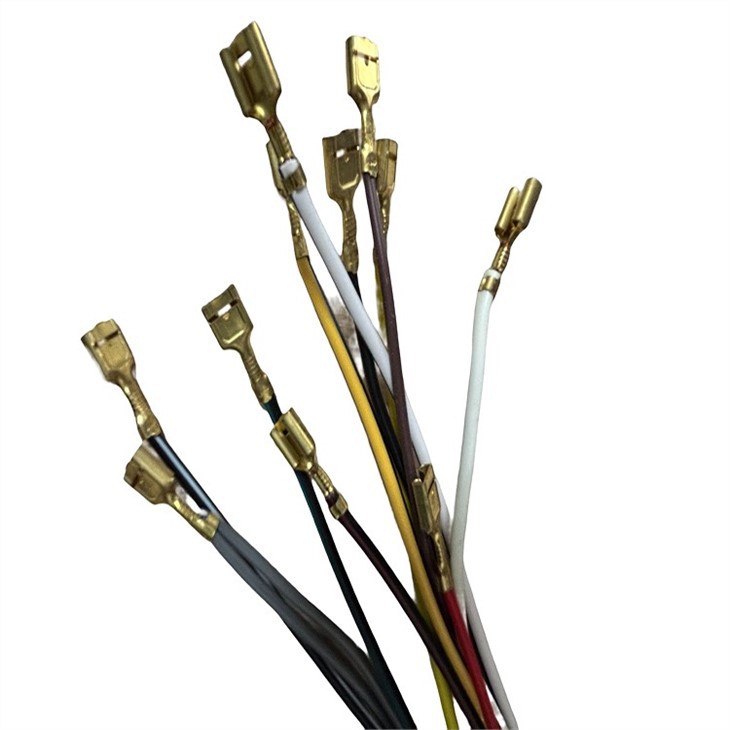

Left: brass push-on terminals, shared across the range. Right: a complete kit laid out end to end, every run cut to its own body.
The complete kit in the second photo is our WK-113-1960 Wiring Harness Kit for VW. The terminals in the first come from the WK-113-1965 VW Wiring Harness Kit, and the WK-113-62-64 Wiring Looms for 1964 VW cover the earlier body. On the repair side, see how long a vintage wiring harness lasts and securing a vintage wiring harness in place.
Building a 1960 Beetle loom, or matching one to a later kit?
Send the model year, a photo of the old loom and the switchgear you plan to keep. We confirm the gauge, terminals, connectors and material before quoting. WhatsApp / WeChat +86 15066885996