

Is 4p - 9537 a differentiable function?
Jun 04, 2025
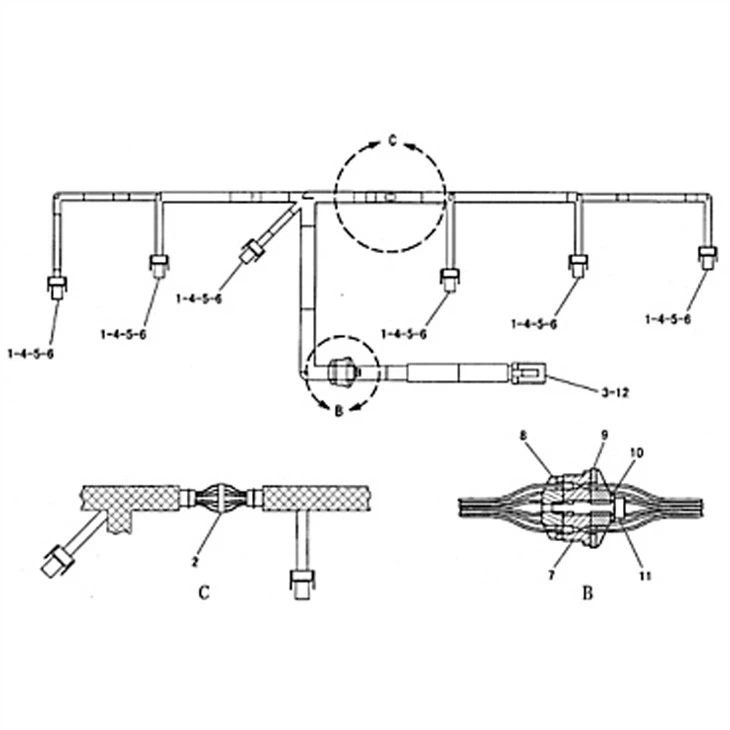
In the realm of construction equipment wiring harnesses, one particular product has caught the attention of many in the industry: the 4p - 9537. As a supplier of this specialized wiring harness, I often find myself delving into various technical aspects to better understand and explain its properties. One question that has emerged in discussions is whether 4p - 9537 can be considered a differentiable function. In this blog, we'll explore this question in detail, while also highlighting the features and applications of the 4p - 9537 Fuel Injector Wiring Harness 4p-9537 Fuel Injector Wiring Harness.
Understanding the Basics of Differentiability
Before we can determine if 4p - 9537 is a differentiable function, we need to have a clear understanding of what differentiability means in the context of mathematics. A function is said to be differentiable at a point if it has a well - defined derivative at that point. In simpler terms, the derivative of a function represents the rate of change of the function at a particular point. Geometrically, the derivative gives the slope of the tangent line to the graph of the function at that point.
Mathematically, a function (y = f(x)) is differentiable at (x=a) if the following limit exists:
(f^{\prime}(a)=\lim_{h\rightarrow0}\frac{f(a + h)-f(a)}{h})
If this limit exists for all points in the domain of the function, then the function is said to be differentiable over its entire domain.
The Nature of 4p - 9537
The 4p - 9537 is a wiring harness, not a traditional mathematical function in the sense of an equation (y = f(x)). However, we can approach this question from a more abstract perspective. We can think of certain aspects of the 4p - 9537, such as its electrical properties (e.g., resistance, current flow) as functions of other variables like temperature, time, or input voltage.
Let's assume that we are interested in the relationship between the current flowing through the 4p - 9537 wiring harness ((I)) and the voltage applied across it ((V)). According to Ohm's law, (I=\frac{V}{R}), where (R) is the resistance of the wiring harness. If the resistance (R) is constant, then the relationship between (I) and (V) is a linear function (I(V)=\frac{1}{R}V).
The derivative of a linear function (y = mx + b) (in our case, (I(V)=\frac{1}{R}V+0)) is given by (y^{\prime}=m). For (I(V)=\frac{1}{R}V), the derivative (I^{\prime}(V)=\frac{1}{R}). Since the derivative exists for all values of (V) (assuming (R) is non - zero), the function (I(V)) is differentiable over its entire domain.
In a more realistic scenario, the resistance (R) of the wiring harness may not be constant. It can change with temperature ((T)) according to the formula (R(T)=R_0(1+\alpha(T - T_0))), where (R_0) is the resistance at a reference temperature (T_0) and (\alpha) is the temperature coefficient of resistance.
Now, the current (I) as a function of voltage (V) and temperature (T) is (I(V,T)=\frac{V}{R_0(1+\alpha(T - T_0))}). To find the partial derivatives of (I) with respect to (V) and (T), we use the rules of partial differentiation.
The partial derivative of (I) with respect to (V) is (\frac{\partial I}{\partial V}=\frac{1}{R_0(1+\alpha(T - T_0))}), and the partial derivative with respect to (T) is (\frac{\partial I}{\partial T}=-\frac{V\alpha}{R_0(1+\alpha(T - T_0))^2}).

As long as the temperature (T) is within a reasonable range and the values of (R_0) and (\alpha) are well - defined, these partial derivatives exist. So, in the context of the electrical properties of the 4p - 9537 wiring harness, we can say that the functions representing these properties are differentiable.
Applications and Related Products
The 4p - 9537 Fuel Injector Wiring Harness is widely used in construction equipment, especially in engines like those found in excavators. It plays a crucial role in ensuring the proper functioning of the fuel injection system by providing a reliable electrical connection.
For those working with excavator engines, other related wiring harnesses are also available. For example, the 222 - 5917 520 - 1511 wiring harness for Excavator CAT C7 Engine and the 418 - 7614 C13 Injector Control Wiring Harness are designed to meet the specific electrical requirements of different engine models.
These wiring harnesses are engineered to be durable, resistant to environmental factors such as heat, moisture, and vibration, and to provide consistent electrical performance. The differentiability of the electrical properties of these wiring harnesses is important because it allows for accurate prediction and control of the electrical behavior, which is essential for the efficient operation of the engine.
Conclusion and Call to Action
In conclusion, while the 4p - 9537 is a physical product (a wiring harness), when we consider its electrical properties as functions of variables like voltage and temperature, these functions are differentiable under normal operating conditions. This differentiability is a key factor in ensuring the reliable and efficient performance of the wiring harness in construction equipment.
If you are in the market for high - quality wiring harnesses for your construction equipment, including the 4p - 9537 Fuel Injector Wiring Harness, please reach out to us for more information. We are committed to providing top - notch products that meet your specific needs. Whether you are looking for a single wiring harness or a large - scale supply, we have the expertise and resources to assist you.
References
- Stewart, J. (2015). Calculus: Early Transcendentals. Cengage Learning.
- Serway, R. A., & Jewett, J. W. (2018). Physics for Scientists and Engineers with Modern Physics. Cengage Learning.