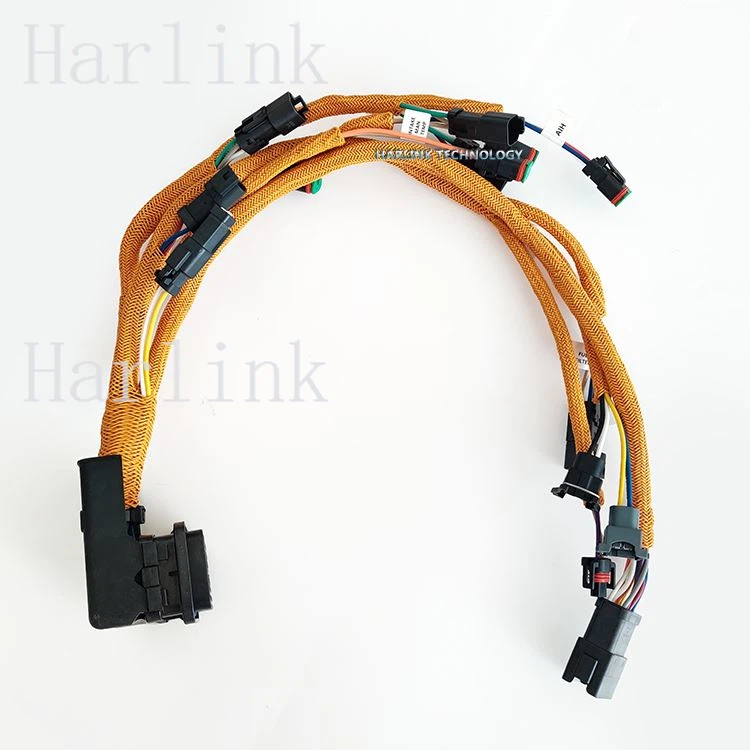
Engine Wiring Harness

What is Engine Wiring Harness


An engine wiring harness is a group of wires that transmits electricity to various parts of your vehicle. While it may sound complicated, it's just a small part that can connect your engine to the fuse box. It's imperative, and if your vehicle is having problems, it could be that your engine wiring harness needs repair or a replacement.Your engine wiring harness is the brain of your vehicle. It controls everything from the airbags to the lights.


Advantages of Engine Wiring Harness
 

Efficient Power Distribution

The engine wiring harness is responsible for distributing electrical power from the battery to various engine components. It ensures that each component receives the appropriate amount of power for optimal operation. Proper power distribution is essential for the smooth functioning of systems such as ignition, fuel injection, and engine control.


Signal Transmission

The engine wiring harness facilitates the transmission of electrical signals between different engine components and the vehicle's computer system. This allows for the exchange of information and data, enabling the computer system to make necessary adjustments for optimal engine performance, fuel efficiency, and emissions control.


Organization and Routing

The engine wiring harness organizes and routes the wires in a structured manner. This ensures that the wires are properly connected and secured, minimizing the risk of tangling, interference, and potential damage. Proper organization also allows for easy identification and troubleshooting of electrical issues.


Protection against Interference and Damage

The engine wiring harness incorporates insulation and shielding to protect the wires from external interference, such as electromagnetic radiation. It also includes protective measures, such as fuses and relays, to prevent electrical overloads and short circuits. These protective features enhance safety and prevent damage to the electrical system.


Simplified Installation and Maintenance

The engine wiring harness is designed to simplify the installation and maintenance processes. It provides a standardized and organized system, making it easier for technicians to connect and disconnect components during repairs or upgrades. This saves time and reduces the risk of errors during installation or maintenance procedures.


Enhanced Reliability and Safety

A properly functioning engine wiring harness ensures the reliable operation of the vehicle's electrical system. It minimizes the risk of electrical failures, malfunctions, and potential safety hazards. A well-designed and maintained wiring harness contributes to the overall safety and dependability of the vehicle.

First 1234 Last 1/4


Why Choose Us
01.

Our Factory

HARLINK is a leading provider of customized wiring harness and electrical solutions for various industries. Our company was established in 2007 by a group of experienced professionals with a shared passion for designing and manufacturing high-quality wiring solutions. Over the years, we have grown to become a trusted partner for manufacturers across the globe.

02.

Production Market

Our company's wiring harness products have achieved success in various regions and markets around the world. Our primary sales regions include Europe, North America, and other countries and regions such as the Middle East, South America, and Oceania.

03.

Product Application

Some of the main areas where our wiring harnesses are commonly used include engineering machinery, agricultural machinery, road machinery, heavy trucks, marine vessels, vintage cars, motorcycles, recreational vehicles, aircraft, medical equipment, special equipment, and vehicles. These applications cover various functions such as power transmission, signal transmission, control, and instrumentation.

04.

Our Service

After-sales support is an important part of our commitment to customer satisfaction. We offer technical assistance, training, and troubleshooting to help customers with installation and maintenance, and provide fast and efficient repair and replacement services for damaged or faulty products.


How to Install Engine Wiring Harness
 

Installing engine wiring harness is an essential task when it comes to upgrading or replacing the electrical system in your vehicle. Wiring harnesses are used to connect various electrical components in your car, such as the stereo, speakers, lights, and more. Installing a wiring harness may seem intimidating, but with the right tools and a basic understanding of electrical systems, it can be a straightforward process. Here are the steps to guide you through installing a car engine wiring harness.

1. Prepare your tools and materials: Before you begin the installation, gather all the necessary tools and materials. You will need a wiring harness kit specific to your car model, wire strippers, crimping tools, electrical tape, zip ties, and a wiring diagram or instruction manual.


2. Disconnect the battery: To avoid any electrical hazards, start by disconnecting the negative terminal of your vehicle's battery. This will prevent any accidental short circuits during the installation process.


3. Identify the wires: The first step is to identify the wires that you need to connect. The wiring harness kit you purchased should come with a wiring diagram or instruction manual that specifies the color coding for each wire. Match each wire to its corresponding component or location in your vehicle.


4. Remove the old wiring: If you're replacing an old wiring harness, remove it carefully without damaging any connected components. Cut the wires close to the connectors using wire cutters or strippers and save any connectors that you can reuse.


5. Connect the new wiring harness: Start by matching the wires from the harness kit to the wires you identified in your vehicle. Strip the ends of each wire using wire strippers and twist them together. It's essential to ensure the wires are securely connected before proceeding.


6. Crimp the connectors: Once the wires are twisted together, use crimping tools to attach connectors to each joint. Crimping provides a secure connection and prevents any wire from coming loose. Make sure to follow the instructions provided with your wiring harness kit for proper crimping techniques.


7. Secure the wires: After connecting all the wires, use electrical tape to wrap each joint and prevent any contact with other wires. This step ensures a secure and insulated connection. Additionally, use zip ties to bundle and secure the wiring harness neatly to prevent any interference with other vehicle components.


8. Test the connections: Before reassembling any removed components, test your connections to ensure proper functionality. Reconnect the vehicle's battery and check if all the connected electrical components are working as intended.


9.Reassemble and tidy up: Once all the connections are tested and working correctly, reassemble any removed components in reverse order. Make sure to route the wiring harness neatly and secure it in place using zip ties or tape.


Major Types of Engine Wiring Harness

Airbag Harness – Controls the opening of the airbag in the vehicle.
 

Main Harness – Controls instruments, control panel, guidance system, multimedia, and electronic equipment. Forms part of the chassis wiring harness together with the front and rear harnesses.
 

Engine Harness – Manages the key functions around the engine including engine controller, oil controller gate, transmission plug housing, air pipe sensors, pressure sensors, and water temperature sensors.
 

Body Wiring Harness (or Body Harness or Floor Harness) – Keeps the air conditioning system, back sonar, navigation, dimmer switches, and speakers functioning.
 

Battery Harness – Delivers the main power to the other units. Serves as a connecting bridge between the engine and other vehicle components.
 

Door Wiring Harness – Found in car doors. Controls door and window lock, door and window power, and the speaker.
 

Roof Harness – Located in the car's roof and controls roof features, including the sunroof.
 

Front Wiring Harness – Forms part of the chassis wiring harness together with the main and rear harnesses. Controls air conditioner fan, cooler fan, power sensor, temperature sensor, pedal sensor, speed limit sensor, oxygen sensor, and more.

195-7336 Engine Wiring Harness


Engine Wiring Harness Design Process and Principles
 

Power distribution design
Vehicle power supply system design is reasonable, is directly related to the normal work of the auto electric parts or not and the safety of the whole vehicle, therefore, automotive wiring harness design basic starting point of the whole world is give priority to in order to safety. The whole electric system consists of three parts: the direct power supply system of the battery (usually called constant or 30). Pick up by this part of the power load is usually the car safety or important parts, the main aim is to provide electricity for the less as far as possible control, to ensure that these items even if the car won't start can also brief to work properly, for easy to site maintenance. For example: power supply of engine ECU and engine sensor, working power of fuel pump, power of ABS controller, diagnosis interface power, etc. The power supply system (commonly known as IG, 15 or ON) is controlled by the ignition switch. This distributor is basically used only when the engine is working, from the power of the generator to avoid the possibility of power supply for the battery. For example: instrument power supply, brake lamp power supply, airbag power supply, etc. When the engine starts off, the load is removed (commonly known as ACC power). This distributor is usually loaded with heavy load and does not need to work when the car is starting. Generally, there are cigarette power supply, air conditioning power supply, power supply, wiper power, etc.


Line protection design
The line protection is to protect the wire and protect the circuit. Protective devices mainly include fuse, circuit breaker and fuse link.
1. The selection principle of the fuse engine, ECU, ABS, etc., has great influence on the performance and safety of the whole vehicle. In addition, the electronic parts that are easily disturbed by other electrical equipment must be equipped with a single fuse. The engine sensor, all kinds of alarm signal lights and external lighting, horn and other electrical components have great influence on the performance and safety of the vehicle, but the electric load is not sensitive to the interference of each other. Therefore, this type of electrical load can be combined with each other to use a fuse. The electrical load of the normal electrical components set for the increase of comfort can be combined with each other to use a fuse. The fuse is divided into quick melting and slow melting. The main components of quick-melt fuse are fine tin wire, and the structure of the chip fuse is simple, reliable and robust and easy to detect, so it is widely adopted. The slow-melt fuse is actually a tin alloy sheet, and the fuse of this structure is usually strung into the circuit of the inductive load, such as the motor circuit. Resistive load and inductor load avoid using the same fuse. According to the maximum continuous working current calculation of the electrical components and the capacity of the fuse, according to the empirical formula, the rated capacity of the fuse is equal to 80% (or 70%) of the maximum working current of the circuit.


2. Circuit breaker
The most characteristic of the circuit breaker is recoverability, but its cost is higher and use less. The circuit breaker is usually a thermal-sensitive mechanical device, which USES the different thermal deformation of the two metals to close or connect the contact. A new type of circuit breaker, using PTC solid material as a flow protection element, is a positive temperature coefficient resistor, which is disconnected or connected according to the current or temperature. The maximum advantage of this protective element is that it can be automatically connected when the fault is out, and no manual adjustment and replacement is required.


3.The characteristics of fusible line fusible line is when the line through great overload current, fusible line can be in a certain period of time (usually 5 s or less) fuse, which cut off power supply, prevent to produce malignant accidents. The fusible line is also composed of conductor and insulating layer, and the insulation layer is generally chloro-sulfonated polyethylene material, because the insulation layer is thicker, so see. It's thicker than that of the same specification. Fuse wire is usually connected directly to the battery of the battery. The common nominal cross section of fusible line is 0.3mm2, 0.5mm2, 0.75mm2, 1.0mm2, 1.5mm2, and even the fusible line of more large sections, such as 8mm2. The length of wire segment of the fusible line is divided into (50 or 5) mm, (100 + or 10) mm, (150 + + 15) mm3. The fusible line should have obvious signs, and when it is fused, its mark shall still exist for replacement.


How Does the Engine Wiring Harness Work
 

There are many cables in the engine wiring harness that work to connect electricity to your vehicle parts. This vehicle part has many sensors, and they work to ensure that everything in your vehicle is in working order. Some of these major systems in your car are fuel and transmission. When you get a check engine light, you have the engine wiring harness to thank.


It works by using these cables and a fuse box. They wire the electricity produced by the engine to the various parts and sensors. It is created using high-temperature plastic or rubber because the engine heats up a lot. That could cause the engine wiring harness to melt over time. And while this is a rare occurrence, it does happen.


Think of this part of the vehicle like the brain. Without it, it wouldn't be possible to get the information your vehicle needs. It's always working overtime to relay the data your vehicle needs to function correctly. Whenever a sensor goes off, it's because the engine wiring harness alerted the sensor of the problem.


What Are the Common Causes of the Engine Wiring Harness
264-5114 1856010C95 For Dorman
21950837 WIRING HARNESS For VOLVO
546-2154 Wiring Harness For Caterpillar
520‑7000 Wiring Harness Replacement For CAT

Wire harness as the machine "blood vessels", bear the role of energy and communication transmission, just like people will be sick, the harness will be used for a long time a variety of failures wiring harness common what are the causes of failure and failure?


Wiring harness of the common fault in general there are poor contact with the connector, the short circuit between the wires, open circuit, ground, burn, etc., the reasons for the failure can be summarized as these aspects:

Natural damage: Any product will have a period of use, of course, is no exception wiring harness, especially with the use of the wiring harness will shorten the life of the harness, the wire aging, insulation rupture, mechanical strength decreased significantly, causing short circuit between the wires , open circuit, grounding, etc., resulting in wire bundles burned.


Non-normal use: Engine wiring harness overload and power supply voltage is too high and other reasons, will lead to high temperature due to high heat, resulting in short circuit or harness burn failure.


Man-made reasons: The production and processing of wire harnesses, non-standard operation techniques sometimes damage the harness, resulting in poor wiring harness, and some can not be found in the quality inspection, often appear in the equipment after a period of time after the short circuit, but now harness processing equipment manufacturers more and more advanced, this phenomenon is currently relatively less.


FAQ
 

Q: What is the raw material for engine wiring harness?

A: Wire harnesses, also known as wire harnesses, are made from various materials, including copper, aluminum, insulated, and voltage. Wire harnesses are one of the most common materials and wire connectors. They are made in various materials, including aluminum, insulated, copper.

Q: What does an engine wiring harness consist of?

A: The wiring harness is the combination of electrical cables, or assembly of wires, that connects all electrical and electronic (E/E) components in the automotive vehicle, like sensors, electronic control units, batteries, and actuators.

Q: What material is used for engine wiring harnesses?

A: Webbing is the material that provides the strong and flexible backbone of a harness and ties together all of the weight bearing parts, including the belt, the leg loops, and the belay loop. Traditionally webbing has been made from nylon or polyester.

Q: What is an engine wiring harness?

A: An engine wiring harness is an organized set of wires, cables, connectors and terminals that controls a vehicle's electrical system. Engine wire harnesses relay electrical power and control information to outlying components such as: Alternators. Audio Systems. Batteries.

Q: How do you test an engine wiring harness?

A: Turn on the switch powering the accessory and grab your multimeter. We're about to check for voltage. Touch the multimeter's negative lead to any good ground, and place the positive lead on the non-working vehicle accessory's positive terminal or wire leading to it to see if there is voltage flowing to the accessory.

Q: What are the common faults of engine wiring harness?

A: Harnesses can easily stretch or crack when exposed to extreme temperatures, humidity, moisture, and vibrations. Incorrect wiring size, an unorganized wiring arrangement, or a faulty crimping method are all areas where mistakes could occur during assembly.

Q: Can you drive with a bad engine harness?

A: Faulty wiring harnesses can cause problems like engine shutdowns, ignition issues, and malfunctioning electrical parts. Most wiring harnesses last for several years, but they can fail prematurely. Avoid driving a car with a faulty wiring harness.

Q: What does the engine wiring harness connect to?

A: An engine wiring harness is constricted wires, cables, terminals, and connectors controlling a vehicle's electrical system. It relays electrical power and control information to components such as batteries, alternators, fuel injectors, fuses, audio systems, blower motors, fuel injectors, and computers.

Q: Can engine wiring harness be replaced?

A: Overlay wiring can also be used in the damaged area, however the entire harness must be replaced if the corrosion exceeds 6 inches (15 cm). If terminals are corroded at the connector, the terminal can be replaced. However, the entire wire must be overlayed if corrosion exceeds 6 inches (15 cm).

Q: How do I know if my engine wiring harness is good?

A: Look at the connectors and check for corrosion or other signs of damage. Examine the insulating wire wrapping for signs that it has cracked, dried out or warped. These are the kind of changes that can affect the performance of your wiring harness.

We're professional engine wiring harness manufacturers and suppliers in China, specialized in providing high quality customized service. We warmly welcome you to buy high-grade engine wiring harness at competitive price from our factory. Contact us for quotation.

230-6279, Engine Wiring Harness for Komatsu, 235-8202

(0/10)

clearall