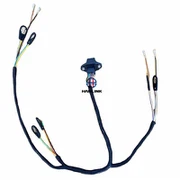

Can You Re-Color a Tractor Wiring Harness? What Actually Works
Oct 20, 2026
Tractor wiring is not car wiring. Tractors run 24/7 in mud, dust, and heat, so their color codes serve a harsher purpose. Modern tractors (post-2010) largely follow SAE guidelines. SAE J1128 assigns red to 12V constant power, pink to ignition, black to ground, and yellow to lights. These are assembly-line aids, not laws. They speed up factory techs, not a farmer tracing a dead circuit at 2 a.m. during harvest. That gap is why re-coding earns its keep.
Why bother
Two motives drive the work. The broken case appears when original insulation has faded until power and sensor wires look identical, or a replacement harness uses a scheme different from the previous owner's. The practical case shows up when an owner color-codes every baler circuit bright green and cuts wire tracing from an hour to ten seconds.
Two ways to do it
Label instead of re-coloring. Industrial heat-shrink tube labels survive 100°F heat and grease. Colored crimp connectors (red=power, black=ground, yellow=lights) flag a circuit even on a gray wire. Both options stay cheap and reversible.
Change the actual color only when needed. Heat-shrink the stripped section in your chosen color with a heat gun (180°F+, not a hair dryer), applying even heat to avoid weak bubbles. Or replace the wire outright. Solder the joint because crimps loosen under vibration, then heat-shrink it. On an already-damaged harness this path wins twice: a new color and a stronger wire at once.
Before touching anything, photograph the original harness. Memory fails mid-project.
Three rules you can't ignore
- Leave safety circuits alone. Seat and PTO interlocks use distinctive colors so mechanics spot them fast. Re-coloring one has turned a no-start diagnosis into a shop accident.
- Check road laws. Public-road tractors must keep standard signal colors (amber front, red rear). One owner took a $1,500 ticket for non-compliant turn-signal wiring.
- Document the result. Record every wire, its new color, and its circuit. Keep spare lengths of each color for mid-season breaks.
Modify or buy custom?
Tractors under roughly 10 years old use sealed connectors that make teardown risky, so a custom harness is simpler. We build custom tractor harnesses, plus heavy-duty utility and reverse-trike harnesses, to your pinout. You pick the colors and add circuits like USB or a backup camera, built for farm conditions.
Cost reality stays clear. Modifying runs $50–$150 in supplies. A custom harness starts near $300. For a 100HP tractor you work on 40+ hours a year, the saved time pays back. For a garden tractor, modify and skip the $300.
Your harness is your livelihood. Take your time, document everything, skip safety and road-light circuits, and call a tractor specialist, not a car one, if you stall.