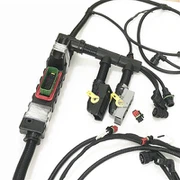

wiring harness wrapping protection
Oct 14, 2024
The main functions of the harness wrapping are wear resistance, flame retardancy, corrosion resistance, interference prevention, noise reduction, and beautification. Generally, the following wrapping design schemes are formulated according to the working environment and space size.
-The working environment of the engine harness is harsh, so it is wrapped with corrugated tubes with high flame retardancy, waterproofness, and high mechanical strength.
-The working environment of the engine compartment harness is also relatively poor. Most branches are also wrapped with corrugated tubes with good flame retardancy, and some branches are wrapped with PVC tubes.
-The working space of the instrument line is small, and the environment is relatively good. It can be fully wrapped with tape or wrapped with flowers.
-The working space of the door line and the canopy harness is small. It can be fully wrapped with tape, and some branches can be wrapped with industrial plastic cloth; the thinner canopy wire can be directly glued to the body with sponge tape.
-The chassis harness has many contact points with the body and frame, so it is wrapped with corrugated tubes to prevent harness wear.
The following is a brief introduction to the performance of several major wrapping and protective materials:
(1) Corrugated pipe: Corrugated pipe generally accounts for about 60% or even more in wire harness wrapping. The main feature is good wear resistance, high temperature resistance, flame retardancy and heat resistance in high temperature areas. The temperature resistance of corrugated pipe is generally between -40-150℃. Its material is generally divided into PP and PA. PA material is better than PP material in terms of flame retardancy and wear resistance; but PP material is stronger than PA material in terms of bending fatigue resistance.
(2) PVC pipe: The function of PVC pipe is similar to that of corrugated pipe. PVC pipe has good flexibility and resistance to bending deformation, and PVC pipe is generally closed, so PVC pipe is mainly used at the branch of the wire harness to make the wire transition smoothly. The heat resistance temperature of PVC pipe is not high, generally below 80℃.
(3) Tape: Tape plays the role of bundling, wear resistance, insulation, flame retardancy, noise reduction, and marking in wire harnesses, and generally accounts for about 30% of the wrapping materials. Wire harness tape is generally divided into three types: PVC tape, flannel tape, and cloth-based tape. PVC tape has good wear resistance and flame retardancy; its temperature resistance is around 80°C, its noise reduction is poor, and its price is relatively cheap. Flannel tape and cloth-based tape are made of PET. Flannel tape has the best wrapping and noise reduction properties, and its temperature resistance is around 105°C; cloth-based tape has the best wear resistance, and its maximum temperature resistance is around 150°C. The common disadvantages of flannel tape and cloth-based tape are poor flame retardancy and high price.
(4) Rubber parts: In addition, when the wire harness passes through the body sheet metal via, rubber parts are generally used for transition to play the role of wear resistance, waterproofing, and sealing. Mainly distributed in the following parts: the interface between the engine and the cab, the interface between the front cabin and the cab (2 places in total on the left and right), the interface between the four doors (or the back door) and the car body, and the fuel tank inlet. Commonly used materials are generally natural rubber, neoprene, silicone rubber, EPDM, etc.